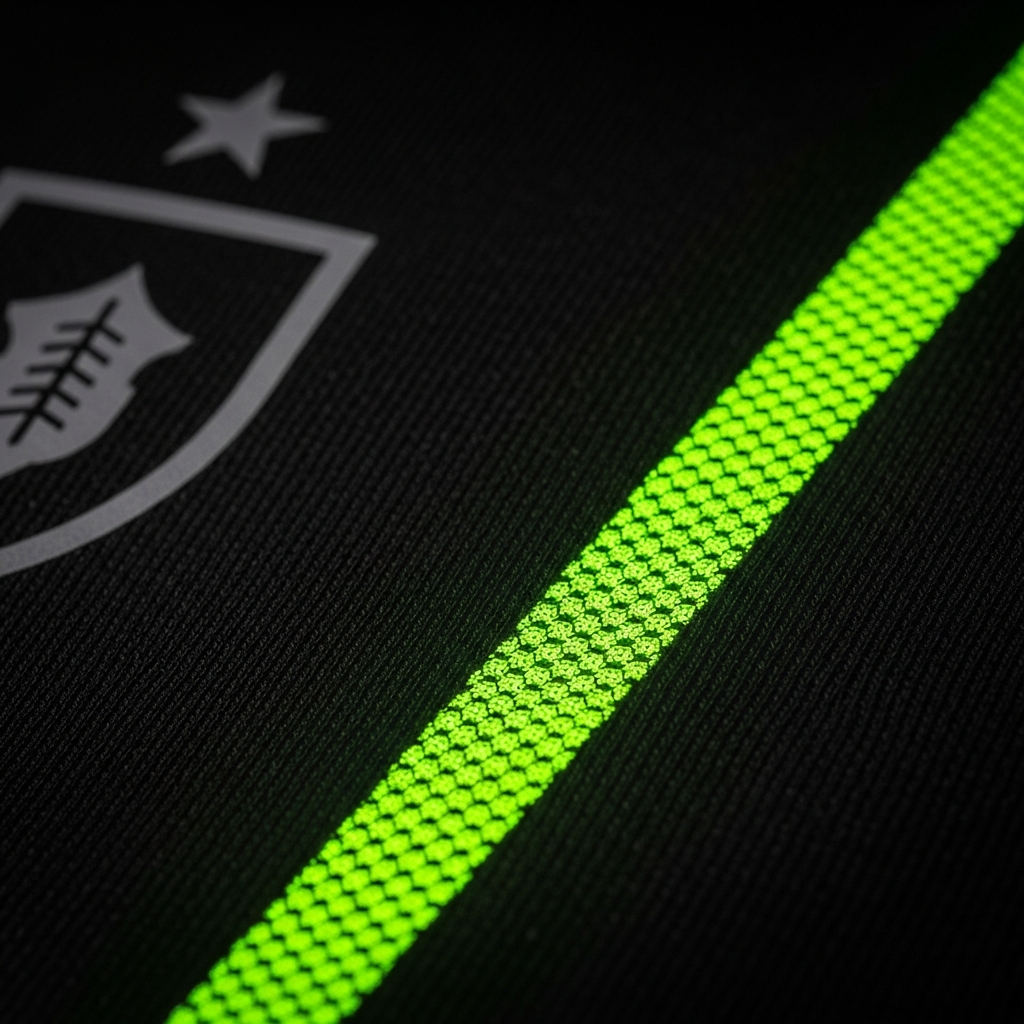
Have you ever noticed how a football kit just pops up on your screen? It’s not just about a cool design. Instead, it’s a deliberate science. The difference between a kit looking sharp on a 4K broadcast versus appearing amateurish is a masterclass in aesthetic planning and technical graphic design.
Modern kits are engineered for the camera, balancing team identity with the harsh reality of stadium floodlights and high-definition sensors. This is where visual communication meets performance technology. Professional designers don’t just ask, “Does it look good?” They ask, “Is it TV-readable?” From the fabric’s finish to the font’s legibility, every element is chosen to look crisp, clear, and professional to a global audience. Consequently, understanding these principles reveals the hidden genius behind your favourite team’s uniform.
Clarity is King: The Science of On-Screen Legibility
The primary job of a kit on camera is instant identification. If viewers and commentators can’t read the names and numbers, the design has failed. Therefore, designers follow strict rules to ensure every detail is perfectly legible.
-
Luis Diaz Steals the Show as Colombia Survive a Scare Against Debutants Uzbekistan Focus Keyphrase: Uzbekistan Colombia World Cup 2026 result Secondary Keywords: Luis Diaz goal assist Colombia, Daniel Munoz goal World Cup, Jaminton Campaz winner Colombia, Abbosbek Fayzullaev Uzbekistan goal, Colombia Group K World Cup 2026, Estadio Azteca World Cup, Uzbekistan World Cup debut, Fabio Cannavaro Uzbekistan coach, Cucho Hernandez assist, World Cup 2026 Group K standings Meta Description: Luis Diaz scored a goal and set up another as Colombia survived a spirited Uzbekistan fightback to win 3-1 at the Estadio Azteca, with substitute Jaminton Campaz settling it in stoppage time. Published: June 19, 2026 | Category: FIFA World Cup | Reading Time: ~6 minutes Colombia Needed a Hero. Luis Diaz Volunteered. It was supposed to be straightforward. Colombia, the Copa America runners-up, arrived at the Estadio Azteca with a squad full of established quality and a debutant opponent many expected them to brush aside comfortably. For long periods, that script played out exactly as written. Then Uzbekistan, managed by World Cup winner Fabio Cannavaro, decided they had other ideas. What followed was a contest far tighter and far more dramatic than anyone inside the Azteca anticipated — settled only deep into stoppage time, and only because Luis Diaz refused to let his country’s World Cup comeback start with anything other than victory. Colombia 3-1 Uzbekistan. A goal and an assist from Diaz. A nervy finish that nobody saw coming. First Half — Colombia Control, But Cannot Find the Breakthrough Early A Frustrating Start for the South Americans Colombia had the better of the opening exchanges from the very first whistle, but found themselves repeatedly denied by a deep, disciplined Uzbekistan defensive setup. Jhon Arias fired Colombia’s first real chance narrowly wide from outside the box. Moments later, Diaz struck the post after a driving run, only to be bundled off the ball by Manchester City defender Abdukodir Khusanov in the aftermath — a foul that earned Khusanov a yellow card alongside a moment of unintended comedy as he collected a pitch-side cameraman in the process. The pattern continued. Colombia probing. Uzbekistan absorbing. The breakthrough refusing to arrive. Munoz Breaks the Deadlock (40′) Six minutes before half-time, the pressure finally told. Diaz picked himself up after the earlier foul and produced the moment that mattered. Gathering possession after a stalled Uzbekistan attack, he clipped a beautifully weighted pass into the path of Daniel Munoz, who swivelled smartly inside the box and steered a superb finish beyond goalkeeper Utkir Yusupov. It was Munoz’s third international goal — and the perfect reward for a Colombian side that had dominated every statistical measure of the first half. Uzbekistan, remarkably, had failed to register a single touch inside the Colombian box throughout the entire opening 45 minutes. The large Colombian travelling support, filling significant portions of the Azteca in yellow, erupted. Chants of “Vamos Colombia” rolled around the stadium. Half-Time: Colombia 1-0 Uzbekistan Second Half — Uzbekistan Roar Back Into the Contest A Historic Equaliser (60′) Whatever Fabio Cannavaro said to his players at half-time, it worked. Uzbekistan emerged with considerably more attacking intent and were rewarded with their first real opportunity of the match on the hour mark. Dostonbek Khamdamov found Eldor Shomurodov inside the box, whose effort was parried low by goalkeeper Camilo Vargas — but the Colombian could not hold it. Abbosbek Fayzullaev reacted fastest, nodding home the loose ball from close range. It was Uzbekistan’s first-ever World Cup goal, scored on their tournament debut. The small but passionate band of Uzbek supporters inside the Azteca made themselves heard, their drums echoing around the stadium in response to Colombia’s earlier chants. For five minutes, the contest hung in genuine balance. Diaz Restores the Lead (65′) It did not last. Gustavo Puerta released Diaz into space, and the Bayern Munich winger did the rest himself — side-footing a composed finish across goal and beyond Yusupov’s despairing dive. Colombia’s lead was restored. Diaz now had a goal and an assist to his name on his country’s return to the World Cup stage — exactly the kind of individual quality his club form across 51 appearances and 49 goal involvements had promised he could deliver on the international stage. Uzbekistan Refuse to Go Quietly To their enormous credit, the World Cup debutants did not collapse after falling behind for a second time. Bekhruz Karimov burst forward on a thrilling run that was eventually halted by a crucial intervention from Jhon Lucumi just as he prepared to shoot. Moments later, Karimov tried again from distance — a thunderous strike that crashed against the crossbar with Vargas well beaten. Akmal Mozgovoy fired narrowly off target in the closing stages. Azizbek Amonov saw a shot blocked after good build-up play. Uzbekistan were throwing everything forward, sensing that a remarkable point against established Copa America finalists was within reach. Campaz Seals It at the Death (90+9′) The drama was not finished. Deep into the ninth minute of stoppage time, substitute Cucho Hernandez chased down a long ball that looked destined to go out of play, somehow retained possession on the byline, and whipped a delicious cross across the face of goal. Fellow substitute Jaminton Campaz arrived perfectly and powered a header beyond Yusupov to settle the contest once and for all. Colombia 3-1 Uzbekistan. Relief and celebration in equal measure on the Colombian bench. Full-Time: Colombia 3-1 Uzbekistan Match Facts DetailColombiaUzbekistanGoalsMunoz (40′), Diaz (65′), Campaz (90+9′)Fayzullaev (60′)Possession56%33%Shots158Shots on Target42Expected Goals (xG)1.621.16Attendance80,000+—VenueEstadio Azteca, Mexico City— The Standout Performer — Luis Diaz Forget the early lack of fanfare around his arrival at this tournament. Luis Diaz has just made absolutely sure that nobody overlooks him again. A goal. An assist. A constant menace down the left channel that gave Uzbekistan’s defence problems all evening. Diaz arrived at the World Cup with little of the spotlight that has followed Mbappe, Messi, Haaland, and Kane through the opening matchdays — but his performance against Uzbekistan was a clear statement that he intends to be part of that conversation by the time this tournament finishes. His club record — 49 goal involvements in 51 appearances for Bayern Munich across all competitions — translated directly onto the World Cup stage. Colombia’s South American flair and creativity flowed through him from the first whistle to the last. A Word for Uzbekistan — Pride in Defeat There should be no shame attached to this result for the World Cup debutants. Uzbekistan, managed by the legendary Fabio Cannavaro, were disciplined and well-organised for long periods, restricting Colombia to relatively limited clear-cut opportunities despite their territorial dominance. Their response after falling behind — scoring their first-ever World Cup goal and then continuing to push for an equaliser deep into stoppage time — showed genuine character. Karimov’s crossbar strike, Mozgovoy’s late effort, and the overall fight shown in the second half will give Cannavaro plenty to build on heading into their next group match against Portugal. What It Means for Group K Colombia’s victory sends them top of Group K after the opening round of matches — a position made even sweeter by events earlier in the day, when Portugal were held to a 1-1 draw by DR Congo, opening up an opportunity that Colombia seized gratefully. Group KPlayedPointsGD🇨🇴 Colombia13+2🇵🇹 Portugal110🇨🇩 DR Congo110🇺🇿 Uzbekistan10-2 Colombia next face DR Congo on June 23 in Guadalajara, while Uzbekistan take on Portugal the same day in Houston — a fixture that now carries significant weight for both sides’ qualification hopes. The Numbers Behind a Remarkable Record This victory extends Colombia’s strong recent record in World Cup group-stage football to seven wins in their last eight matches at this stage of the tournament — a statistic that speaks to the consistency Nestor Lorenzo has built into this squad heading into the new expanded format. For a nation that missed out on the 2022 World Cup entirely, this winning return to the tournament’s biggest stage will be celebrated long after the final whistle. Final Thoughts: The Tournament’s 48 Teams Now All Seen With this result, every one of the 48 teams competing at the 2026 World Cup has now played their opening fixture — and the picture, as pundits have noted, is beginning to take real shape. Some sides look like genuine contenders. Others look capable of being dark horses. And debutants like Uzbekistan have already shown, in defeat, that they belong on this stage and have the character to compete with nations who have far greater World Cup pedigree. Colombia, for their part, have exactly the start they wanted — three points, a player announcing himself as a genuine star of the tournament, and a group table that now looks very favourable heading into matchday two.
1 week ago
This is achieved through a focus on high contrast. For instance, league regulations often demand a minimum contrast ratio between the jersey fabric and the lettering. This is why you see bold white numbers on red shirts or sharp black lettering on yellow kits. It’s a simple rule that guarantees clarity.

Analysis of broadcast-ready typography and contrast ratios.
Furthermore, the typography itself is a specialized field.
- Font Choice: Fonts are typically bold and condensed. This style allows for long player names to remain large and readable without looking cramped.
- Counter Space: Modern league fonts are designed with large “counters” (the holes in letters like ‘O’ or ‘A’). This prevents them from blurring into a solid shape when viewed from a distance.
- The Number Box: On striped shirts, a solid box is often placed on the back. This provides a clean, high-contrast background, ensuring numbers don’t get lost in the pattern.
Taming the Light: The Battle Against Glare and Moiré
Stadium lighting is incredibly bright, and modern cameras pick up every reflection. Consequently, managing light is one of the biggest challenges in kit design. A professional look depends on controlling how fabric reacts to intense light.
Avoiding the Shimmer
Thin pinstripes often clash with digital sensors, creating a flickering mess known as the Moiré effect. Pro kits use calibrated widths to ensure visual stability.
First, designers almost always choose matte finishes over shiny ones. Matte fabrics diffuse light, which makes colors look solid and rich on screen. Shiny materials, in contrast, create “hot spots” or glare that wash out logos and colors. This is why most professional kits use sublimation, a process that dyes graphics directly into the fibers, avoiding the plastic-like sheen of older iron-on decals.
It Starts with the Fit: The Anatomy of a Pro Kit
Beyond graphics and color, the silhouette of a kit is fundamental to its professional appearance. There is a significant difference between the “Replica” kits sold to fans and the “Authentic” versions worn by players. The professional kit is defined by its athletic, slim fit.
This tailored cut isn’t just for style. A tighter fit prevents the fabric from bunching up or flapping during a sprint, which can look sloppy in slow-motion replays. High-end fabrics are also more structured, so they drape cleanly and hold their shape, even when soaked with sweat.
In addition, advanced fabrics are crucial for maintaining a sharp look throughout the 90 minutes. Materials like Nike’s Dri-FIT ADV, as detailed on Nike News, are designed to wick moisture away instantly. This prevents the heavy, dark sweat patches that can make a kit look unkempt and unprofessional mid-match.
A Player’s Perspective: When Performance Meets Aesthetics
Ultimately, the player has to wear the kit. Their comfort and confidence are paramount, and their feedback directly influences design. This is where the philosophy of “look good, feel good, play good” comes into play. Psychologists call this “enclothed cognition”—the idea that what we wear directly influences our mindset.
Players want kits that feel like a second skin. Any friction or unnecessary weight is a distraction. This is why pros prefer heat-pressed crests over embroidered ones, as they sit flat and prevent chafing. It’s also why many players customize their kits, such as cutting holes in their socks to relieve calf pressure.
Moreover, the visual design impacts on-field performance. Players need to identify teammates with a glance. High-contrast kits that “pop” against the green pitch can actually speed up decision-making during a fast-paced game. Brands like Adidas now hold player workshops to gather this crucial feedback, which you can learn more about on Adidas News.
Conclusion: A Symphony of Design and Technology
In the end, what makes a football kit look professional on camera is a complex symphony of intentional design choices. It is the result of meticulous aesthetic planning where every element serves a purpose. From the broadcast-safe color palette and anti-Moiré patterns to the player-approved athletic fit, a modern kit is a high-performance tool built for the world’s biggest stage. It’s a testament to how graphic design, when blended with technology and psychology, can elevate a simple uniform into a piece of professional art.