Agentic AI Is Revolutionizing In-Game Strategy
Beyond reflection. Beyond dashboards. Discover how real-time autonomous systems are transforming the sidelines of professional sports.

The era of post-game analysis is over. For decades, coaches relied on reviewing tape and stats after the final whistle. Today, however, a new revolution is unfolding on the sidelines. Agentic AI—intelligent systems that can reason, plan, and act in real time—is transforming sports from a game of reflection into a live-strategy battleground. This shift has ignited the B2B sports tech market, a sector projected to reach nearly $45 billion in 2026. Consequently, teams are no longer asking “what happened?” but “what should we do, right now?”
The New Playbook: From Analytics to Autonomous Agents
For years, sports analytics meant descriptive charts and heat maps. Coaches and analysts had to interpret this data to find an edge. Agentic AI, in contrast, closes the loop. It acts as a digital strategist, providing prescriptive, real-time recommendations.
Traditional AI
Gives you a dashboard showing where your opponent scored from.
Agentic AI
Tells your bench to adjust the defensive formation before the opponent can take their next shot.
This move from passive dashboards to active “co-strategists” is powered by millisecond-level processing. It combines live video tracking, player biometrics, and historical data to deliver a single, actionable suggestion to a coach under immense pressure.
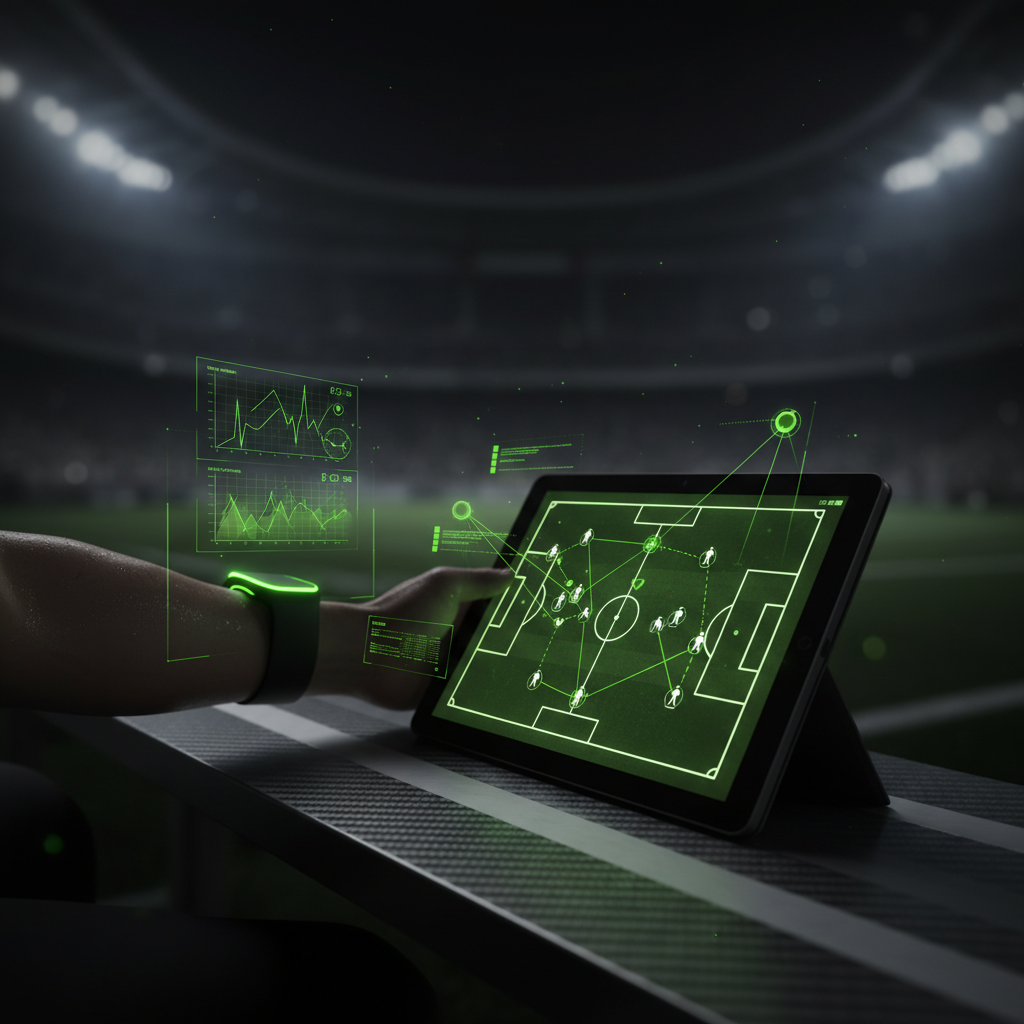
The NFL Sideline Viewing System: Instant tactical recalibration.
The AI-Powered Sideline in Action
Top-tier leagues across the globe are already embedding this intelligence on the sidelines. They are turning data into immediate tactical advantages.
NFL: The AI-Enhanced Sideline
Since the 2025 season, the NFL’s Sideline Viewing System has been supercharged. The 2,500+ Microsoft Surface tablets now use AI agents to auto-filter plays. Instead of manually searching for a specific past play, a coordinator sees the AI instantly flag relevant clips based on the live down, distance, and formation. For instance, if a defense is struggling against a particular motion, the AI presents the adjustment solution before the next drive even begins.
NBA: Predicting Fatigue and Spacing
The NBA uses the “Dragon” platform from Second Spectrum, which captures the entire surface area of a player’s body. AI agents analyze this complex data to monitor defensive spacing and shot probability. Furthermore, if the AI detects that a player’s “cut speed” has dropped by just 8%—a sign of fatigue invisible to the human eye—it can recommend a substitution before a costly defensive mistake occurs.
Global Soccer: The Tactical Co-Strategist
In La Liga and the Belgian Pro League, Sportian’s AI agents monitor team formations and passing patterns in real time. If an opponent suddenly shifts to a high-press formation, the system alerts the bench within seconds. It simultaneously proposes a counter-tactic, such as lowering the midfield line, to maintain possession and exploit the new space.
Biometric Analysis: Preventing fatigue-related errors with AI precision.
Navigating the Hurdles: Integration and Ethics
Integrating this advanced B2B technology is not without its challenges. The biggest hurdle is no longer collecting data, but rather orchestrating it.
The Challenge of Data Silos
Professional teams often use 10-15 different tech vendors for everything from GPS tracking to heart rate monitoring. These systems rarely talk to each other, creating isolated pools of information. Consequently, teams spend significant resources just cleaning and merging data so it can be viewed on a single dashboard.
Player Privacy vs. Performance
Perhaps the most critical challenge is navigating the ethical landscape. With wearables tracking everything from sleep patterns to heart rate variability, athletes have become 24/7 data subjects. This raises complex questions about data ownership and privacy. Landmark legal cases like “Project Red Card” argue that player performance stats are personal data under GDPR. In response, major leagues in the US are updating their Collective Bargaining Agreements (CBAs) to protect players.
Conclusion: The Future is a Human-AI Partnership
Agentic AI is not about replacing the human coach. Instead, it’s about augmenting their intuition with the power of data at scale. The “gut feeling” of a seasoned manager, when combined with millions of in-game simulations, creates an unstoppable competitive edge. The teams winning in 2026 and beyond will be those that master this human-AI collaboration. They will have a digital coach on the sideline, ready to help make the perfect call when the game is on the line.