That crucial moment in the match happens, the camera is perfectly framed, but the stream stutters and dies. For any broadcaster, this is the ultimate nightmare. A stadium pitch-side is one of the most hostile environments for wireless signals on the planet.
Relying on a single connection is no longer an option. Therefore, achieving a stable, broadcast-grade live stream requires a modern, multi-layered connectivity strategy. This guide breaks down exactly how to solve pitch-side connectivity issues for good.
The Pitch-Side Problem: Why Your Stream Fails
Before finding solutions, you must first understand the challenges. A sports stadium is a perfect storm of radio frequency (RF) interference and network congestion. Simply put, standard Wi-Fi doesn’t stand a chance against these massive hurdles.
The “Stadium Squeeze”
Imagine 50,000 fans. Now, imagine them all trying to upload a video of a goal to social media at the same second. This simultaneous demand completely saturates public Wi-Fi and local cellular towers. Consequently, the network grinds to a halt.

Interference & Obstacles
The environment itself works against you. The metal structure of a stadium can create a “Faraday Cage” effect, trapping and bouncing signals. Furthermore, you face a chaotic mix of competing RF signals from hotspots and staff radios.
Finally, the crowd itself is a major obstacle. The human body is mostly water, which is excellent at absorbing Wi-Fi signals. This creates unpredictable dead zones right where you need a connection most.
The Foundation: Building a Bulletproof Network
To overcome these issues, you need to move beyond public networks and build a deterministic, professional-grade infrastructure. This is the essential first layer of a reliable setup.
Private 5G: The VIP Lane
Private 5G (P5G) is the current gold standard for mission-critical broadcasting. Unlike the public 5G network your phone uses, a P5G network provides a dedicated, interference-free “fast lane” for your data.
Next-Gen Wi-Fi: Wi-Fi 7
If you must use Wi-Fi, it has to be the latest standard. Wi-Fi 7 (802.11be) is a game-changer for two key reasons. First, it uses the much cleaner 6 GHz band, which is far less crowded. Second, its Multi-Link Operation (MLO) feature allows a device to send data across multiple frequencies simultaneously.
The Unbreakable Pipe: Bonding and Failover
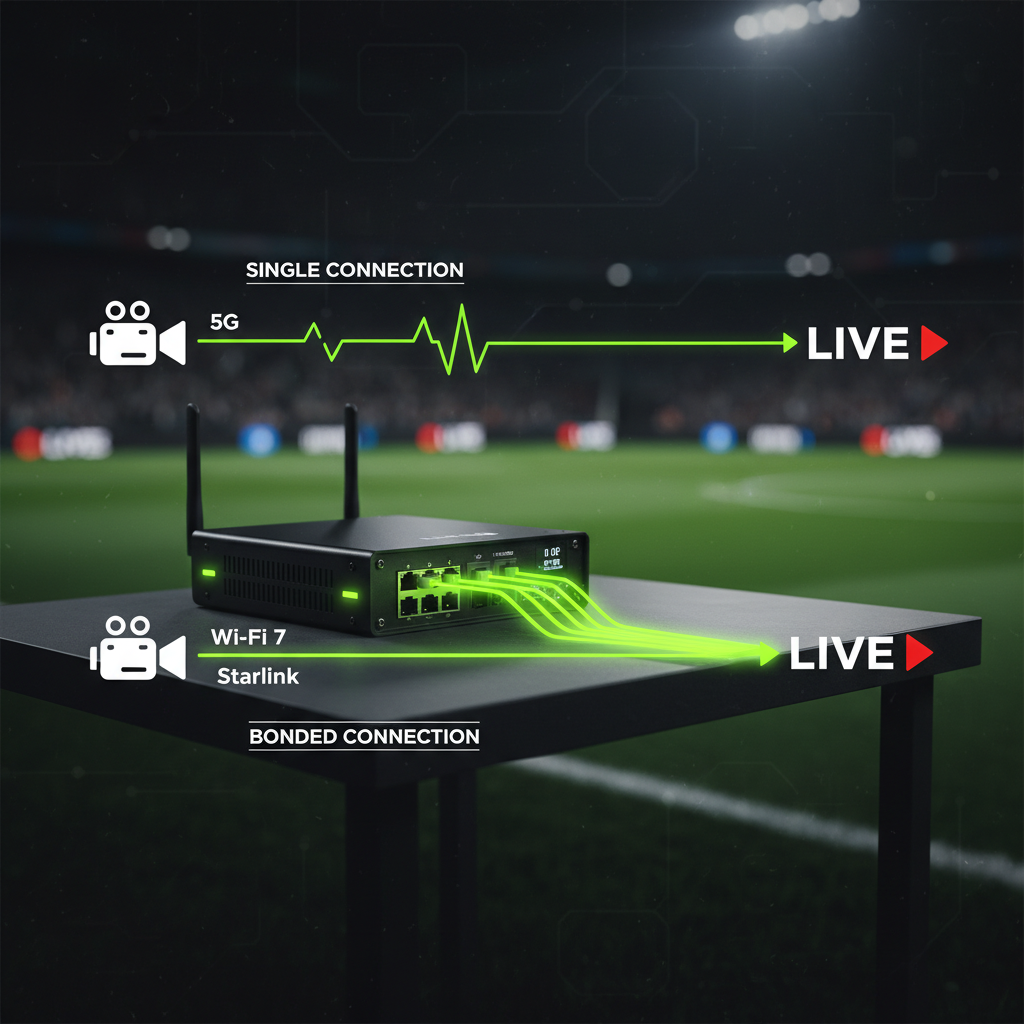
Professional broadcasters never rely on a single internet source. The second layer of your strategy involves merging multiple connections into a single, highly resilient data pipe using a technique called IP bonding.
Multi-Path Bonding
Hardware from brands like LiveU, TVU, or Peplink combines multiple sources—SIM cards, dedicated Wi-Fi, and Ethernet—at the packet level.
Low-Latency Satellite
For ultimate redundancy, systems like Starlink are now integrated into bonded setups, providing low-latency (25-50ms) connections.
Smart Streaming: Software and Protocols
The final layer is the software that packages and sends your video data. Using modern protocols and efficient compression is vital for maintaining stream quality over unpredictable networks.
SRT: The Modern Standard
Secure Reliable Transport (SRT) has replaced older protocols. SRT is brilliant because it can recover lost data packets over unstable networks, ensuring video remains stable even with up to 10% packet loss.
HEVC/H.265 Compression
Efficient compression reduces the amount of bandwidth your stream needs without sacrificing quality. HEVC (H.265) compression is about 50% more efficient than the older H.264 standard.
This means a high-quality 4K stream that once needed 20Mbps can now run perfectly on just 8-10Mbps, a massive advantage when your network connection is under strain.
Conclusion: A Hybrid, Multi-Layered Approach
Achieving a stable, broadcast-quality live stream from the pitch-side is entirely possible, but it demands a robust, hybrid strategy. Forget trying to find a single, perfect Wi-Fi signal. Instead, the professional solution is to bond multiple, diverse connections—such as dedicated stadium Wi-Fi, two separate 5G carriers, and a satellite backup. By running this bonded connection through the resilient SRT protocol, you build a system that can withstand the intense challenges of a live stadium environment and deliver a flawless stream every time.