Why Bench Boost Was the King.
A retrospective look at the monumental Gameweek 33 and the tactical brilliance behind the season’s biggest point-haul event.
Double Gameweek 33 of the 2025/26 season was a monumental moment in Fantasy Premier League (FPL) history. Managers across the globe activated over 2.3 million chips, making it the second-biggest chip-a-thon ever recorded in a single Gameweek. Amid the flurry of Triple Captains and Free Hits, one chip clearly emerged as the most popular. So, what was the go-to choice for FPL managers? The Bench Boost was, by far, the most-played chip in Double Gameweek 33.
A Record-Breaking Gameweek in Numbers
The sheer volume of chips used highlights just how pivotal this Gameweek was. Official FPL data reveals a fascinating split in strategy among the world’s top managers. While several options were on the table, the numbers show a clear preference for maximizing a full squad of 15 players.
823,047 managers
693,021 managers
644,259 managers
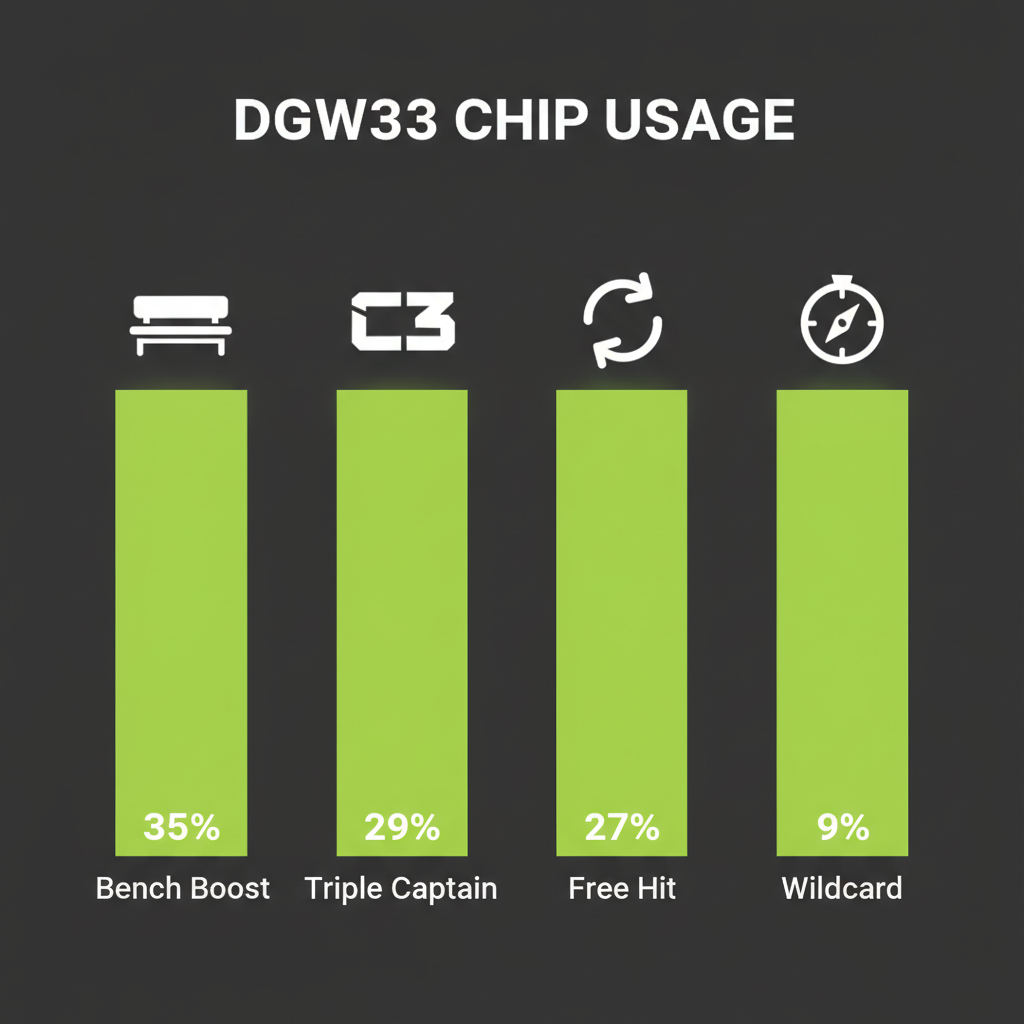
This data confirms that more than one in three active managers opted to play their Bench Boost, trusting their entire squad to deliver points.
Why the Bench Boost Reigned Supreme
The reason for the Bench Boost’s popularity was simple: Gameweek 33 was the largest Double Gameweek of the season. An incredible six teams had the advantage of playing twice, offering a massive potential for points. Consequently, managers planned for weeks to take full advantage.
Teams with Double Gameweeks:
This created a perfect storm for the Bench Boost. Many savvy FPL managers executed a popular strategy: using their Wildcard in the preceding Gameweek 32. This allowed them to build a new squad filled with 15 players from the teams listed above. Therefore, activating the Bench Boost in DGW33 meant getting potential returns from up to 30 individual appearances.
The Key Players Targeted by Millions
To successfully execute a Bench Boost, managers needed the right players. A few key assets became template picks due to their form, fixtures, and price. Manchester City’s Erling Haaland was the standout choice, not only as a core holding but also as the most popular Triple Captain pick for those using that chip.
Beyond the obvious, several other players saw huge ownership:
- Dominic Calvert-Lewin (Leeds): His favourable fixtures and budget-friendly price made him a popular forward.
- Nico O’Reilly (Man City): The young midfielder emerged as a crucial budget enabler, allowing managers to afford other premium assets.
- Cole Palmer (Chelsea): Despite his team’s inconsistent form, Palmer remained a must-have for his reliable FPL returns.
The Free Hit Factor
Interestingly, the high usage of the Bench Boost also explains why the Free Hit was a popular chip. The schedule created a tricky situation. Key teams like Manchester City and Chelsea, who doubled in GW33, had a Blank Gameweek immediately after in GW34. For managers who had not prepared with a GW32 Wildcard, the Free Hit became the only logical way to field a full team for GW34 after loading up on “doublers” for GW33.
Conclusion: A Calculated Gameweek Victory
In conclusion, the Bench Boost was the undisputed king of Double Gameweek 33. Its dominance was a direct result of careful planning by hundreds of thousands of FPL managers who capitalized on the season’s largest Double Gameweek. By using a Wildcard in the prior week, they built powerful squads designed specifically for this moment. This strategic approach, focused on key players like Haaland and Palmer, set the stage for one of the most exciting and high-scoring Gameweeks in recent memory.