
The English Non-League Pyramid: A Pathway to Glory
Discover the intricate system that connects grassroots football to the professional leagues.
From local parks to packed stadiums, the dream of football glory fuels clubs across England. But how does a small, local team even begin the journey to the top? The answer lies in the English Non-League Pyramid, a structured system that connects grassroots football to the professional leagues. It offers a potential pathway, however challenging, for any club to rise through the ranks.
This intricate structure, officially known as the National League System (NLS), is the backbone of English football below the professional tiers. Consequently, understanding its layers and rules is essential for anyone following the journey of their local club.

What is the Non-League Pyramid?
The Non-League Pyramid is a hierarchical system of football leagues in England, sitting directly below the English Football League (EFL), which includes the Premier League. Governed by The Football Association (The FA), the system operates on a fundamental principle: promotion and relegation. In short, successful teams can move up the pyramid, while unsuccessful teams move down.
This structure provides competitive football for hundreds of semi-professional and amateur clubs. Moreover, it ensures that teams compete at a level appropriate to their playing ability, financial stability, and stadium facilities.
The Structure: A Step-by-Step Guide
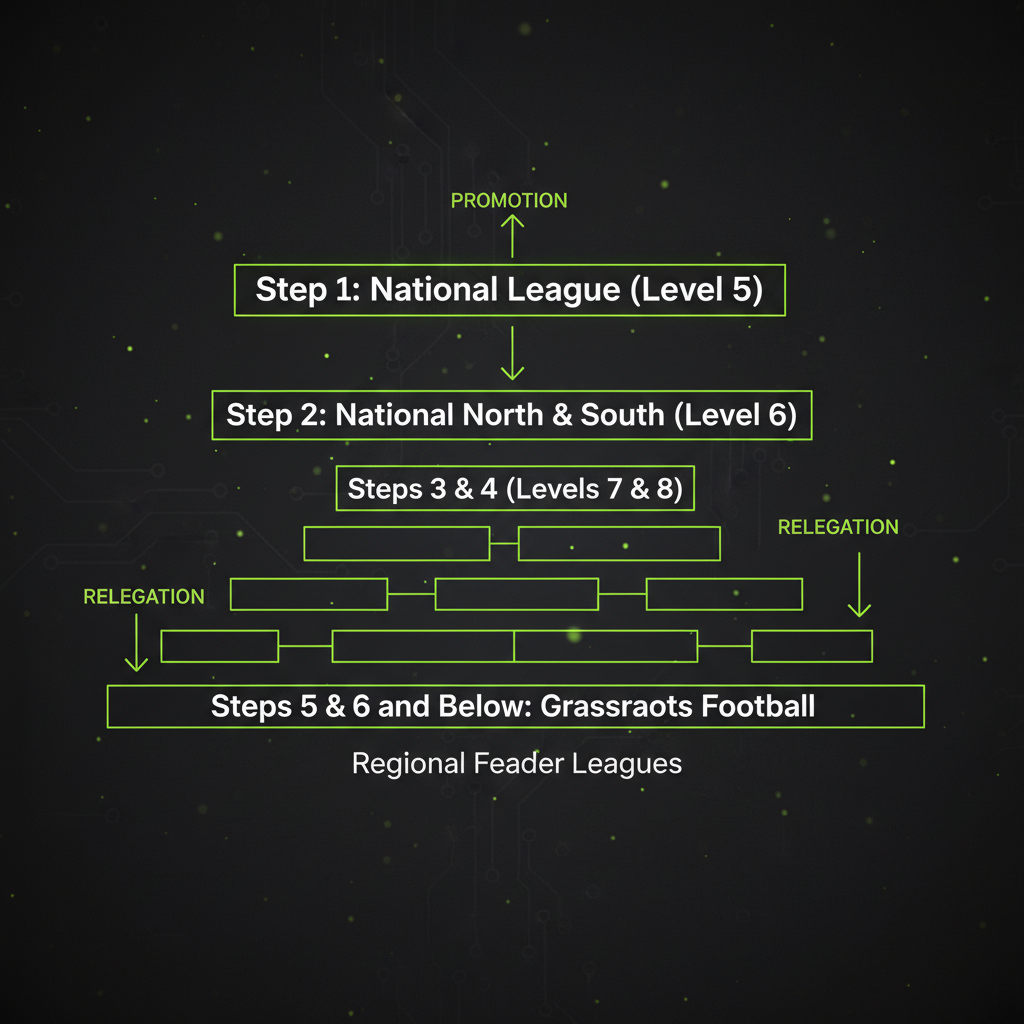
The pyramid is organised into different levels known as “Steps”. The system is easiest to understand by starting at the top, just below the professional leagues.
Step 1: The National League (Level 5)
This is the highest tier of non-league football. It is a single, nationwide division of 24 clubs. Although called non-league, many clubs at this level are fully professional. Each season, two teams earn promotion to the EFL’s League Two, making it the final hurdle before entering the fully professional game.
Step 2: National League North & National League South (Level 6)
Below the National League, the pyramid splits into two regional divisions to reduce travel costs for clubs.
- National League North
- National League South
Each division typically features 24 clubs, which are a mix of professional and semi-professional teams. Champions from each division are promoted to the National League, with another promotion spot available via play-offs in each league.
Steps 3 & 4 (Levels 7 & 8)
As you move further down, the leagues become even more regional. These steps are overseen by three historic leagues, often called the “Trident Leagues”: the Northern Premier League, the Southern League, and the Isthmian League. Step 3 consists of four divisions, while Step 4 expands to eight, covering smaller geographical areas.
Steps 5 & 6 and Below: Grassroots Football
These levels are the heartland of grassroots and community football, featuring hundreds of clubs across England. The divisions become highly localised, run by regional and county football associations. Below Step 6 are the Regional Feeder Leagues, which form the base of the pyramid and allow local amateur teams to begin their climb.
The Dream of Progression: How Promotion and Relegation Work
The constant movement between leagues is what makes the pyramid so exciting. Progression is based on performance, but it’s not always straightforward.
Climbing the Ladder: Automatic Promotion and Play-Offs
Generally, the team that finishes first in their division wins automatic promotion to the step above. However, there are often more promotion spots available. These are decided by play-off matches, typically contested by the teams finishing just below the champion. For example, in the National League (Step 1), the champions go up automatically, while the next six teams enter a play-off for the second promotion spot.
The Other Side: Relegation and Placement
Conversely, teams finishing at the bottom of their division are relegated to the step below. The number of relegated teams varies by league. When a team is relegated or promoted, the FA’s NLS Committee places them in the most geographically suitable division to keep travel manageable for clubs at that level.
More Than Just Points: The Off-Pitch Requirements
On-pitch success is crucial, but it’s not the only factor for promotion. Clubs must also meet strict criteria to ensure they are sustainable and have appropriate facilities for a higher level of football.
Ground Grading Explained
A club’s stadium and facilities must meet the minimum standard for the league they wish to enter. This is known as “ground grading.” Requirements become stricter at each step of the pyramid. Key criteria include:
- Pitch Quality: The playing surface must be in good condition.
- Floodlights: Required for playing evening matches, with specific brightness levels.
- Covered Seating: A minimum amount of covered accommodation for spectators.
- Changing Rooms & Facilities: Adequate facilities for both home and away teams, as well as officials.
A club can be denied promotion if its ground does not meet the grade for the next step. Similarly, a club can even be relegated for failing to maintain the required grade for its current level. These regulations are outlined in detail by the governing body, The FA.

Financial Stability and Licensing
In addition to facilities, clubs must prove they are financially stable. The FA requires clubs in the NLS to hold an annual license, which confirms they are being run sustainably. This prevents clubs from overspending in pursuit of promotion and then collapsing, which protects the integrity of the entire league system. Official league resources, such as The Northern Premier League, often guide member clubs.
Conclusion: A Pathway to Glory
The English Non-League Pyramid is more than just a collection of leagues; it is a dynamic and challenging pathway that embodies the spirit of football. It provides structure, fosters competition, and maintains the dream that any club, no matter how small, can progress based on sporting merit and sound management. While the journey from a local park to professional football is incredibly rare, the pyramid ensures the possibility is always there, fueling the passion of clubs and communities across the country.