
From Non-League to Pro: The Data That Defines an “Elite” Player
The journey from non-league football to the professional ranks used to be a story of luck, a scout’s gut feeling, or a flash of magic in a cup game. Today, that narrative has changed completely. Thanks to advanced AI and sophisticated data analysis, the path once walked by legends like Jamie Vardy is now a calculated science.
For clubs in the English Football League (EFL), non-league (specifically the top tiers of the English National League System) is no longer a blind spot. Instead, it’s a hunting ground where specific statistical benchmarks separate the hopefuls from the truly elite.
What Does “Elite” Actually Mean in Non-League Football?
In the world of data-driven scouting, “elite” is a precise term. It means a player is performing in the top 10% (the 90th percentile) of their league for key metrics. However, the real test is whether these impressive stats hold up against a professional baseline. Scouts and AI platforms now directly compare a National League player’s data to the average performance of a player in League Two. If the numbers overlap, a club has found a potential star.
Consequently, it’s no longer enough to simply be the best player on your team. Aspiring professionals must meet specific, data-defined thresholds across every area of the pitch.

The Striker’s Blueprint: Goals, Grit, and Pressing
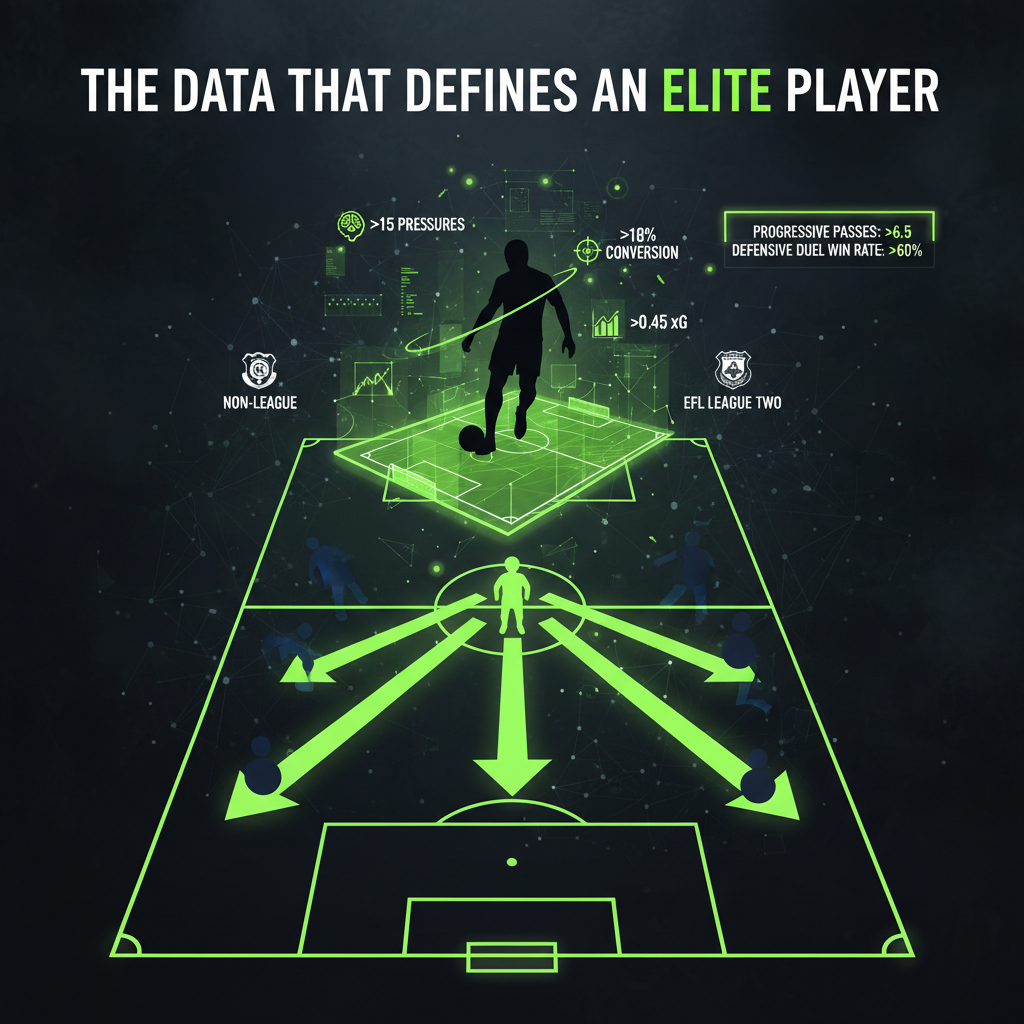
The modern striker is far more than just a goalscorer. They are the first line of defense and a consistent creator of high-quality chances. To be flagged as an elite prospect, a non-league striker must excel in three key areas:
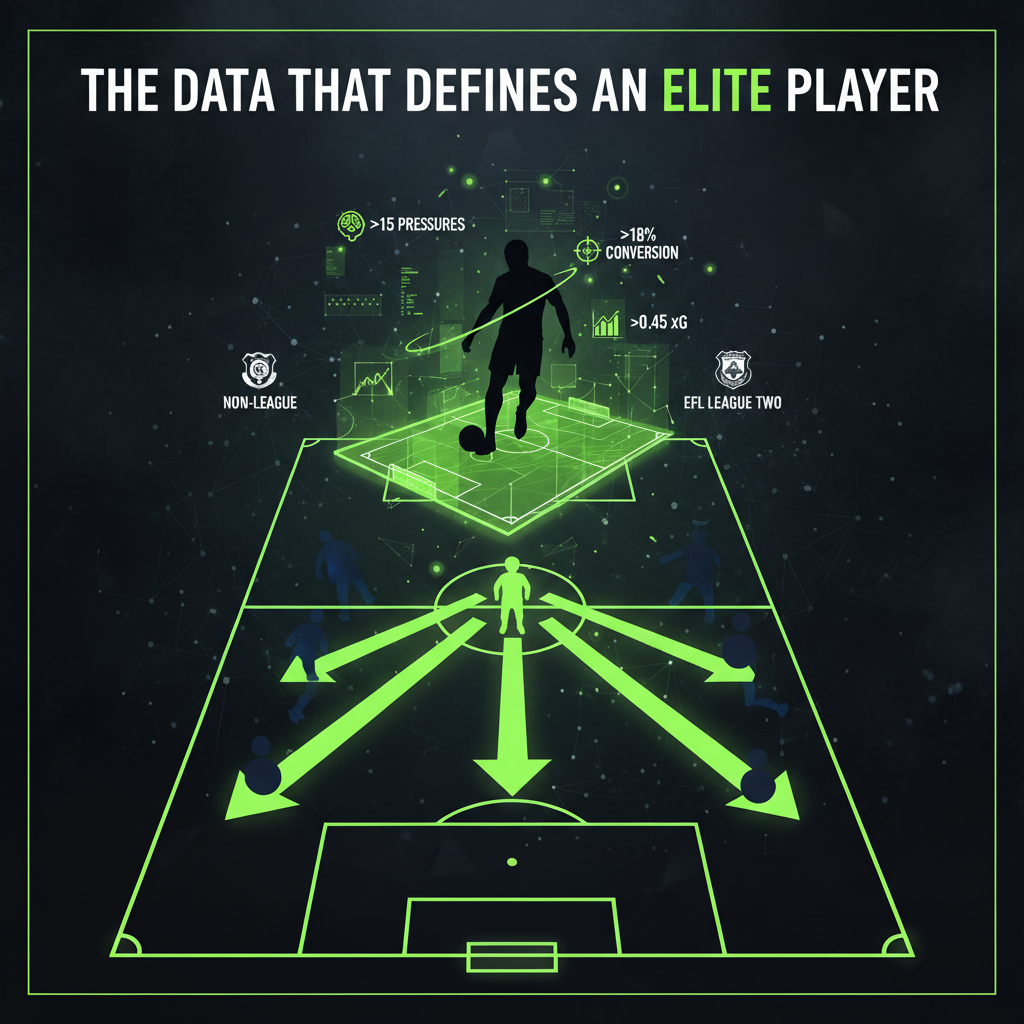
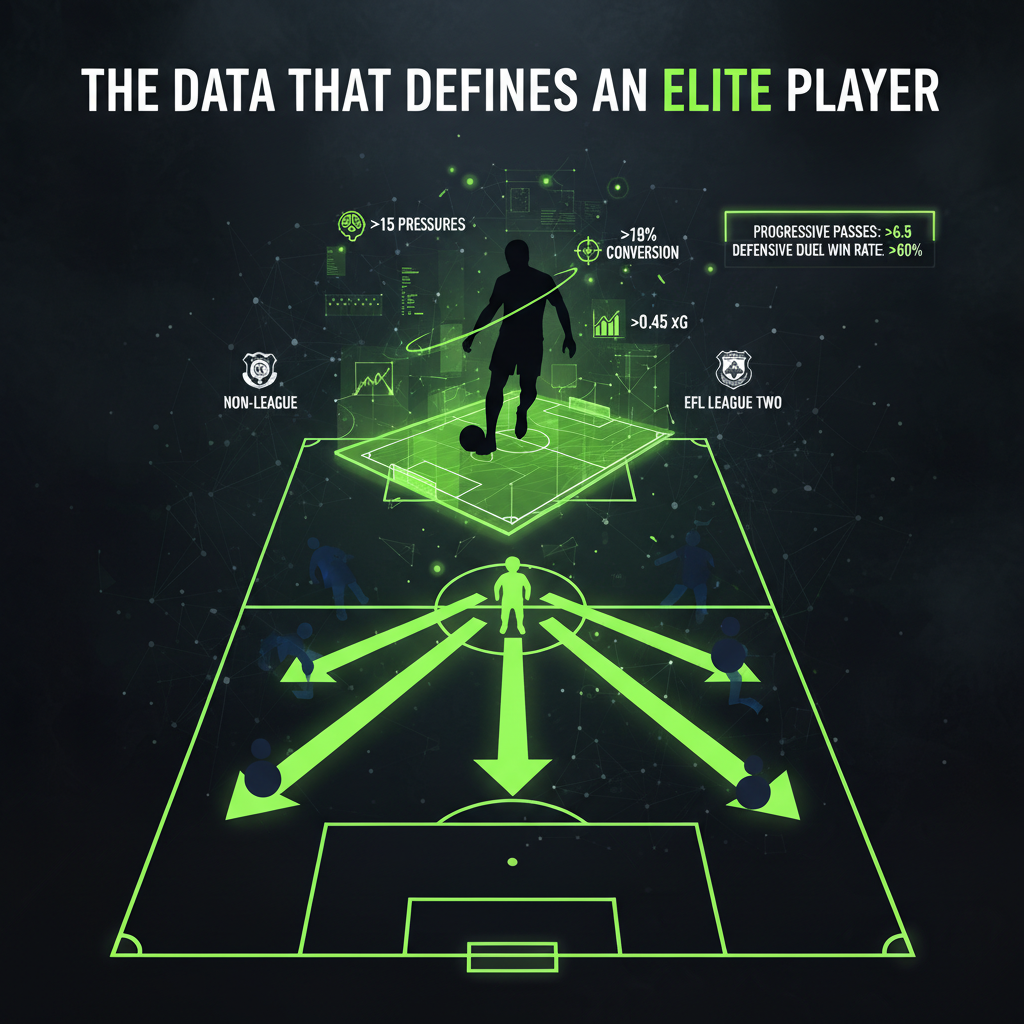
- Expected Goals (xG): An elite prospect must post an xG of over 0.45 per 90 minutes.
- Clinical Finishing: A shot conversion rate of over 18% is critical for professional translation.
- Defensive Pressing: An elite forward must make over 15 defensive pressures per 90 minutes.
The Progressive Midfielder: Breaking Lines
A non-league midfielder with EFL potential must be more than just a tidy passer. They need to be a physical engine that can both create opportunities and dominate their opponent.
Making more than 6.5 progressive passes per 90 shows an ability to break defensive lines. For more on how data platforms track this, check out the Official StatsBomb Blog.
The Modern Center-Back: A Fusion of Steel and Skill
For a defender, making the jump requires a combination of old-school defensive dominance and modern ball-playing ability. The benchmarks are non-negotiable:
How AI Scouting Separates Talent from Hype
Raw numbers are only part of the story. Advanced AI platforms now provide deeper context, which is crucial for making a smart signing. To learn more about these tools, see the Official Wyscout Blog.
These platforms run “virtual transfer simulations,” projecting how a National League player’s stats would translate to a higher division like League Two. Physical data is the final piece of the puzzle, looking for coverage of over 10km per match.
Statistical Red Flags: Why Context Is King
Data also helps scouts identify players whose stats might be inflated. AI can spot several red flags:
- The “Big Fish” Syndrome: Stats might be high simply due to team dominance. AI filters performance against top-tier opposition specifically.
- Set-Piece Inflation: Using Non-Penalty xG (npxG) to confirm open-play threat.
- Efficiency vs Volume: A winger with high volume but a low success rate (under 55%) is often flagged as inefficient.
Conclusion: A New Era of Talent Identification
The gap between non-league and the EFL is no longer a mysterious chasm. It is a bridge built on data. For aspiring players, the message is clear: the numbers you produce today are your CV for tomorrow.
For additional insights on AI in sports, you can explore platforms like the Comparisonator Official Website.