The Fifth Phase: How AI Is Turning Corner Kicks into a Science
In football, a corner kick was once seen as a simple dead-ball opportunity. A hopeful cross into a crowded box. Today, however, elite clubs treat it as the “Fifth Phase” of the game—a highly structured mini-battle where data, not luck, dictates the winner.
This transformation is powered by technologies that can dissect every player’s movement and predict outcomes with startling accuracy. Consequently, teams are turning these low-percentage plays into consistent sources of goals. Let’s explore how this data revolution is changing the game from the ground up.
The Technology Driving the Change
The foundation of this new science is the ability to gather massive amounts of data. In the past, video analysts spent countless hours manually “tagging” events from match footage. They would mark every corner, pass, and shot. This process was slow and often subjective.
Today, AI platforms like Metrica Sports’ Smart Tagging and Google DeepMind’s TacticAI automate this entire workflow. Using advanced computer vision, these systems track the coordinates of every player and the ball.

Delivery Type
Automated classification of inswingers vs outswingers.
Routine Logic
Identifying short-corner vs. near-post flick-on patterns.
Outcome DNA
Mapping the chain from delivery to shot or counter-attack.
From Pixels to Patterns with Geometric Deep Learning
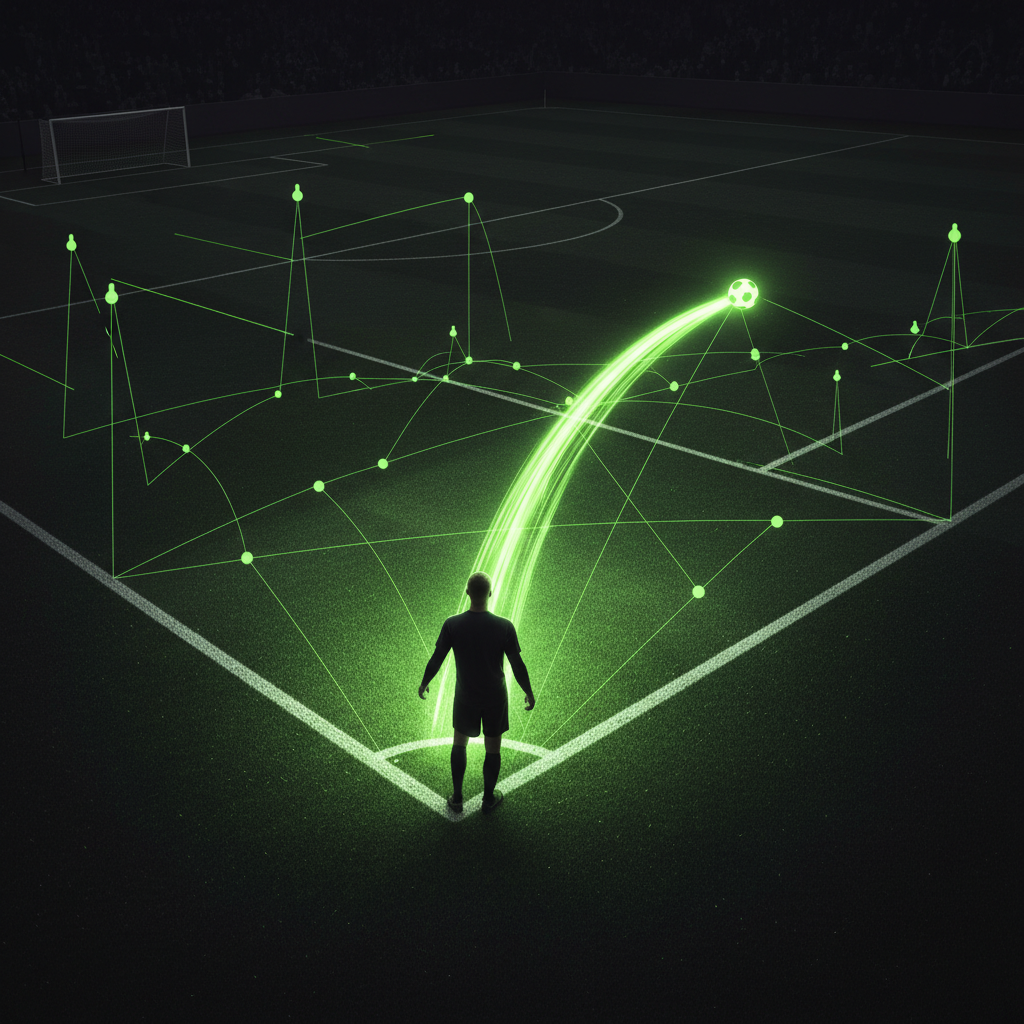
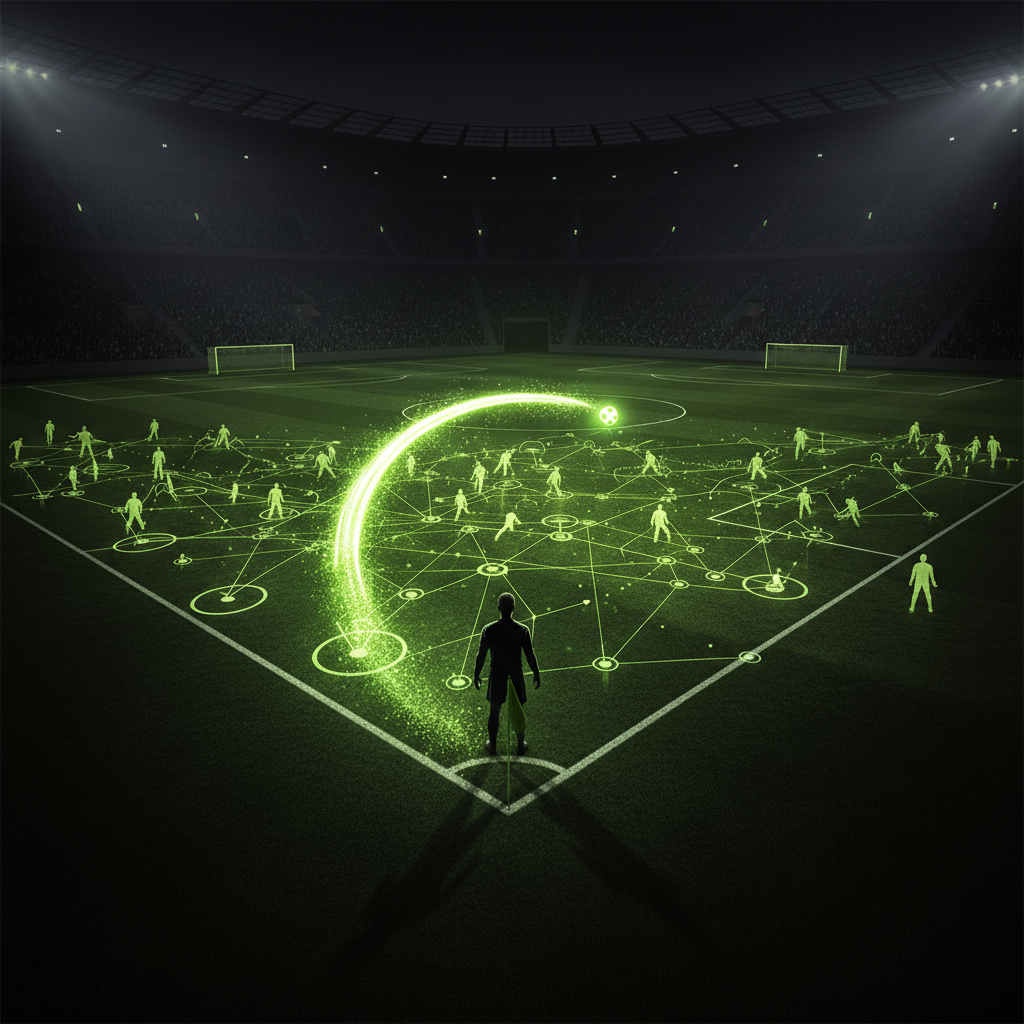
The most advanced systems use a technique called Geometric Deep Learning. Instead of just seeing 22 players, this AI views the pitch as a network. Each player is a “node,” and the technology analyzes the spatial relationships between them. For instance, it can understand how a “blocker” creating space for a “runner” influences the play, even if they never touch the ball.
The Taxonomy of a Corner Kick
To analyze thousands of corners effectively, analysts needed a standardized language. Research has now defined specific offensive and defensive roles, allowing AI to categorize and compare routines.
Offensive Roles
- /The Taker: Precision delivery expert.
- /The Blocker: Screens the GK or key defenders.
- /The Runner: The primary target in the zone.
- /The Decoy: Diverts defensive attention.
Defensive Roles
- /Player-marking
- /Zonal-marking
- /Post Guards
- /Short Defender
Data-Driven Success: What Actually Works?
Inswingers vs. Outswingers
The data provide a clear answer to the age-old debate. While outswingers may lead to more total shots, inswingers have a higher goal conversion rate (around 2.7%).
Masters at Work: Arsenal and Liverpool
Under set-piece coach Nicolas Jover, Arsenal has become the most feared team in Europe. They score a goal roughly every 16 corners, doubling the league average. Their strategy involves meticulously choreographed routines. For more details on key performers, see the Gabriel Magalhães official Premier League player page.
Similarly, Liverpool FC has been working directly with Google DeepMind. As detailed in their research, the Google DeepMind TacticAI blog post explains how AI predicts outcomes and suggests tactical tweaks.
| Metric | Industry Avg | Elite (AI-Optimized) |
|---|---|---|
| Goal Conv. Rate | ~3.0% | 5.0% – 7.0% |
| Shot Creation | ~20.0% | 30.0% + |
| 2nd Ball Retention | ~40.0% | 60.0% + |
The Future is Predictive AI
A coach can use the system to run “what if” simulations. In a blind study, football experts from Liverpool FC were asked to compare TacticAI’s suggestions with the original setups. In 90% of cases, experts preferred the adjustments suggested by the AI.

Conclusion: A New Era
Corner kicks are no longer a game of chance. Through AI-powered video tagging and predictive modeling, they have become a deeply strategic part of modern football. Coaches like Nicolas Jover are the new pioneers, using data to engineer goals.